
Interactive Flat Panels in Government Schools: What the Deployment Process Actually Looks Like
Written by Milap Mehta, EdTech Specialist at Nitek IFP

Milap Mehta
Official Blog Contributor
QUICK ANSWER: Deploying interactive flat panels in government schools in India follows a structured process: budget allocation and scheme identification (PM SHRI, Samagra Shiksha, or state-level schemes), tender floatation and vendor empanelment, infrastructure readiness check (power, wall, internet), installation and commissioning, and post-installation teacher training. The full cycle from approved budget to a functional IFP in the classroom typically takes 3 to 9 months depending on the state and scheme.
India has been putting interactive flat panels into government school classrooms at a scale that would have seemed unlikely five years ago. State after state has launched smart classroom schemes, central government programmes have pushed digital infrastructure into schools that previously had no functioning projector, and the interactive flat panel has become the centrepiece of what a modernised government school classroom looks like.
But between the scheme announcement and the moment a teacher actually uses an IFP to deliver a lesson, there is a process that most coverage of this topic ignores completely. Procurement heads, school principals, district education officers, and edtech vendors who work in this space know that the gap between a sanctioned smart classroom budget and a functional deployment is where most of the real challenges live.
This article covers that process honestly, from scheme identification to post-installation support, including the friction points that are rarely discussed in government tender documents or vendor brochures.
Step 1: Identifying the Right Scheme and Budget Source
Most government school IFP deployments in India are funded through one of three routes: the PM SHRI scheme (PM Schools for Rising India), which focuses on upgrading select government schools into model institutions with modern infrastructure including smart classrooms; Samagra Shiksha Abhiyan, the central government's overarching school education programme, which includes ICT lab and smart classroom components; or state-level smart classroom initiatives, which vary significantly in scope and budget allocation across Gujarat, Maharashtra, Rajasthan, Karnataka, Uttar Pradesh, and other states.
Each scheme has different eligibility criteria, approved vendor lists, and specification requirements for the interactive flat panel. A school principal or district education officer cannot simply choose any IFP brand and purchase it centrally. The vendor must be empanelled under the relevant scheme, and the IFP specifications must meet the scheme's technical requirements, which typically include minimum screen size (usually 65 or 75 inches), resolution (4K), Android OS version, touch point count, and warranty duration.
NITEK NOTE: Nitek's interactive flat panels are designed to meet the specification requirements of major government procurement schemes, including minimum warranty, resolution, OS, and service coverage criteria that most state tenders specify.
Step 2: The Tender Process and What Vendors Are Actually Evaluated On
Once the budget is allocated and the scheme is identified, the implementing authority, typically the state education department or district collectorate, floats a tender for interactive flat panel supply, installation, and maintenance. Government IFP tenders in India evaluate vendors on a combination of technical and commercial criteria.
On the technical side, the key evaluation points are the IFP specification compliance (screen size, resolution, OS version, touch points, OPS slot), the brand's after-sales service network (number of service centres by state, on-site warranty coverage, average response time), and in some cases, reference deployments from prior government school projects. On the commercial side, price per unit and total project cost are evaluated, but L1 pricing alone rarely determines the outcome in well-structured government tenders because the technical qualification round filters out non-compliant vendors first.
For IFP brands, the practical implication is that pan-India service coverage is not optional in government procurement. A brand with service presence only in metros cannot credibly bid for a tender covering 200 schools across Rajasthan or Gujarat. Nitek's service network across Tier 1, Tier 2, and Tier 3 cities, including districts in Gujarat, Maharashtra, Rajasthan, and Karnataka, is a direct response to this procurement reality.
Step 3: Infrastructure Readiness, the Step That Delays Most Deployments
This is where the majority of government school IFP deployments run into delays, and where the gap between scheme announcement and functional classroom is most often lost.
An interactive flat panel requires stable power supply, adequate wall structure for a 50 to 80 kg panel, and ideally a broadband or Wi-Fi connection for content access and cloud-based features. In older government school buildings, particularly in rural and semi-urban areas, none of these three conditions are guaranteed.
|
Infrastructure Requirement |
Common Issue in Govt Schools |
What Needs to Happen |
|
Stable power supply |
Frequent voltage fluctuations, outages |
Voltage stabiliser or UPS installation before IFP arrives |
|
Wall structure |
Older brick walls, no reinforcement |
Civil work to install reinforced mounting bracket |
|
Internet connectivity |
No broadband, weak mobile data signal |
Broadband provisioning or Wi-Fi router installation |
|
Dedicated circuit |
Shared circuits with fans, lights, other loads |
Separate electrical line for the IFP recommended |
|
Room layout |
Fixed benches, columns blocking sightlines |
Minor furniture rearrangement or civil modification |
Experienced IFP vendors conduct a site readiness assessment before scheduling installation. This assessment flags infrastructure gaps that need to be resolved before the panel arrives. Skipping this step, which happens more often than it should in rushed government deployments, results in panels that arrive at schools that are not ready to receive them, causing delays, damage risk, and frustration for the school administration.
Step 4: Installation, Commissioning, and Handover
Once infrastructure is ready, the installation itself, for a single interactive flat panel, typically takes one full working day. This includes mounting, cable management, OS configuration, network setup, pre-loading of required apps or content, and an initial functional check with the school's designated IT contact or head teacher.
For batch deployments covering 20, 50, or 200 schools, a deployment team works in parallel across locations over a period of several weeks. Project management at this scale requires a vendor with logistics capability, not just a product. Nitek's deployment experience across schools in Gujarat, Surat, Rajkot, Ahmedabad, Maharashtra, and Rajasthan means the installation process follows a documented commissioning checklist, with a signed handover report for each school that becomes part of the warranty and service record.
Step 5: Teacher Training, the Most Underestimated Part of the Entire Process
The single biggest reason interactive flat panels in government schools go underused is not hardware failure. It is the absence of adequate teacher training at the point of deployment.
A government school teacher who has spent 15 years in front of a blackboard does not intuitively know how to use an IFP effectively, and a one-hour handover demonstration on installation day is not sufficient. Effective IFP adoption in government schools requires structured training covering basic operation, content access and navigation, annotation tools, connectivity with student devices if applicable, and troubleshooting common issues independently.
NITEK APPROACH: Nitek includes structured teacher onboarding as part of its government deployment process, with on-site training sessions that go beyond button familiarisation to actual lesson integration, helping teachers build the IFP into how they teach, not just where they stand.
Districts and states that have invested in dedicated IFP training programmes for government school teachers consistently report higher utilisation rates than those that treat training as a post-deployment afterthought. For scheme evaluators and procurement officers, making teacher training a contractual deliverable in the tender, not an optional add-on, is the single most impactful change that improves deployment outcomes.
Step 6: Post-Installation Support and Why On-Site Warranty Is Non-Negotiable
A government school IFP deployment is not complete at installation. The panel will be used daily by multiple teachers, in conditions that include chalk dust, humidity variation, and power fluctuations. Hardware issues will occur over a 5 to 7 year deployment lifecycle, and when they do, the school needs a service response that does not require shipping a 60 kg panel to a city service centre.
On-site warranty with a defined SLA, typically 48 to 72 business hours for a technician visit, is the standard that government school deployments should insist on. Several state tenders now explicitly mandate on-site warranty as a technical eligibility criterion for this reason. Brands without a service network in the deployment geography simply cannot meet this requirement.
Nitek's 3-year on-site warranty with pan-India service coverage, including Tier 2 and Tier 3 districts where the majority of government school deployments actually occur, is structured specifically for this deployment context. A school in a district town in Rajasthan or a taluka in Gujarat gets the same service commitment as a school in Ahmedabad or Pune.
Frequently Asked Questions
Which government scheme funds interactive flat panels in Indian schools?
The main schemes are PM SHRI (PM Schools for Rising India) for model school upgrades, Samagra Shiksha Abhiyan for ICT and smart classroom infrastructure, and various state-level smart classroom schemes in Gujarat, Maharashtra, Rajasthan, Karnataka, and other states. Each has different eligibility criteria and approved vendor requirements.
How long does it take to deploy an interactive flat panel in a government school?
From budget allocation to a functional IFP in the classroom, the typical timeline is 3 to 9 months. Tender floatation, vendor evaluation, and purchase order issuance take the majority of this time. Actual installation, once infrastructure is ready, takes 1 to 2 days per school.
What infrastructure does a government school need before installing an IFP?
The school needs stable power supply (voltage stabiliser or UPS recommended), a reinforced wall bracket for the panel's weight, a broadband or Wi-Fi connection, and a dedicated electrical circuit for the IFP. These should be assessed and resolved before the panel arrives on site.
Why do many government school IFPs go unused after installation?
The primary reason is insufficient teacher training. A one-hour handover is not enough for teachers to integrate the IFP into their daily lessons. Deployments that include structured, multi-session teacher training programmes consistently show higher utilisation rates.
Does Nitek supply interactive flat panels for government school schemes in India?
Yes. Nitek's interactive flat panels meet the technical specifications required by major government procurement schemes, including 4K resolution, Android OS, multi-touch, OPS slot, and 3-year on-site warranty with pan-India service coverage across Tier 1, Tier 2, and Tier 3 cities.
What a Successful Government School IFP Deployment Actually Requires
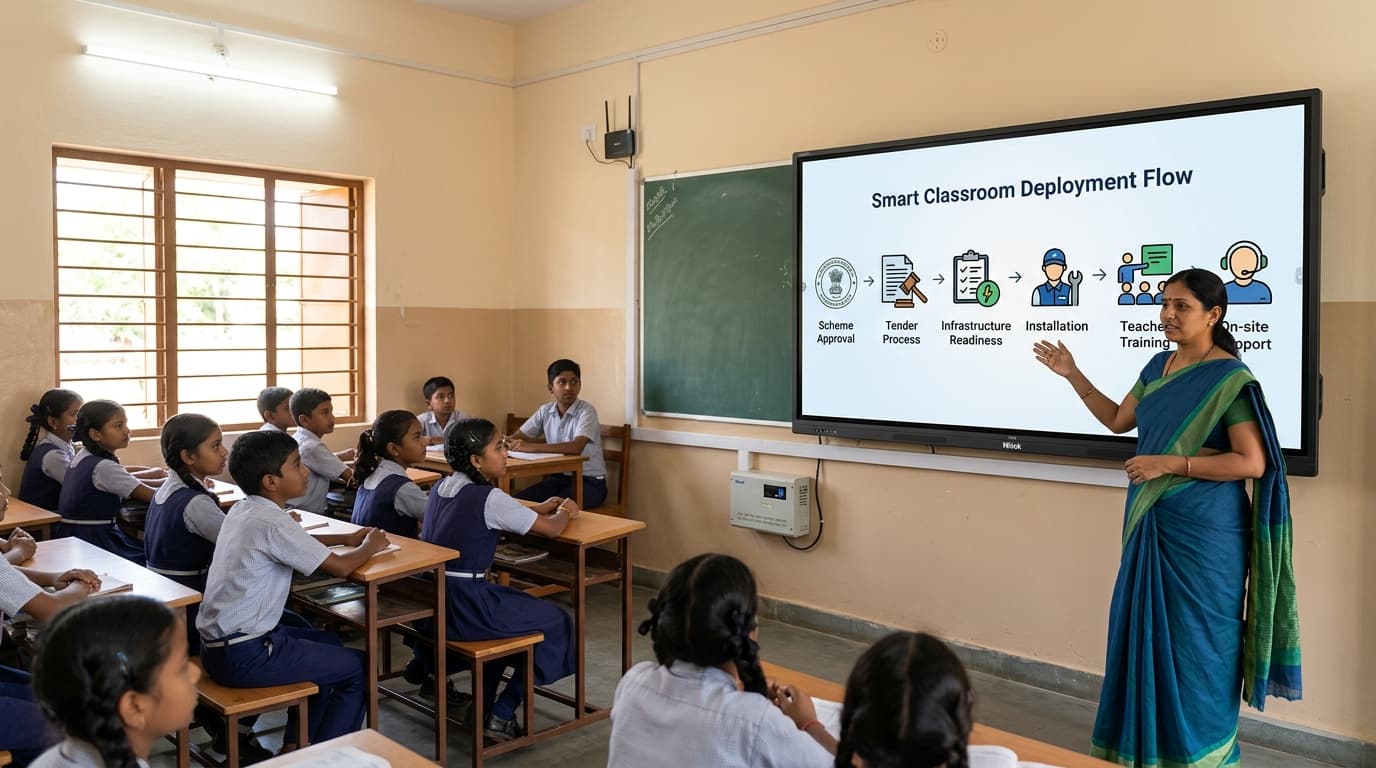
The interactive flat panel itself is rarely the problem in a government school deployment. The panel that stays switched off in the corner of a classroom for months got there because one or more of these six steps was rushed or skipped: scheme alignment, compliant procurement, infrastructure readiness, proper installation, teacher training, and on-site support.
For school principals, district education officers, and state procurement teams evaluating IFP vendors, the right question is not just which panel has the best spec sheet. It is which vendor has the deployment experience, service network, and post-installation commitment to make the panel actually work in a government school in your district, five years from now.
Nitek has built its government school deployment process around exactly these requirements, from tender compliance and pan-India service coverage to structured teacher onboarding and 3-year on-site warranty in districts where the bulk of India's smart classroom investment is actually going.
To explore Nitek's government school IFP solutions or request a deployment consultation, visit nitekifp.com.