How Interactive Flat Panels Align With NEP 2020's Digital and Experiential Learning Goals
Written by Milap Mehta, EdTech Specialist at Nitek IFP
Milap Mehta
Official Blog Contributor
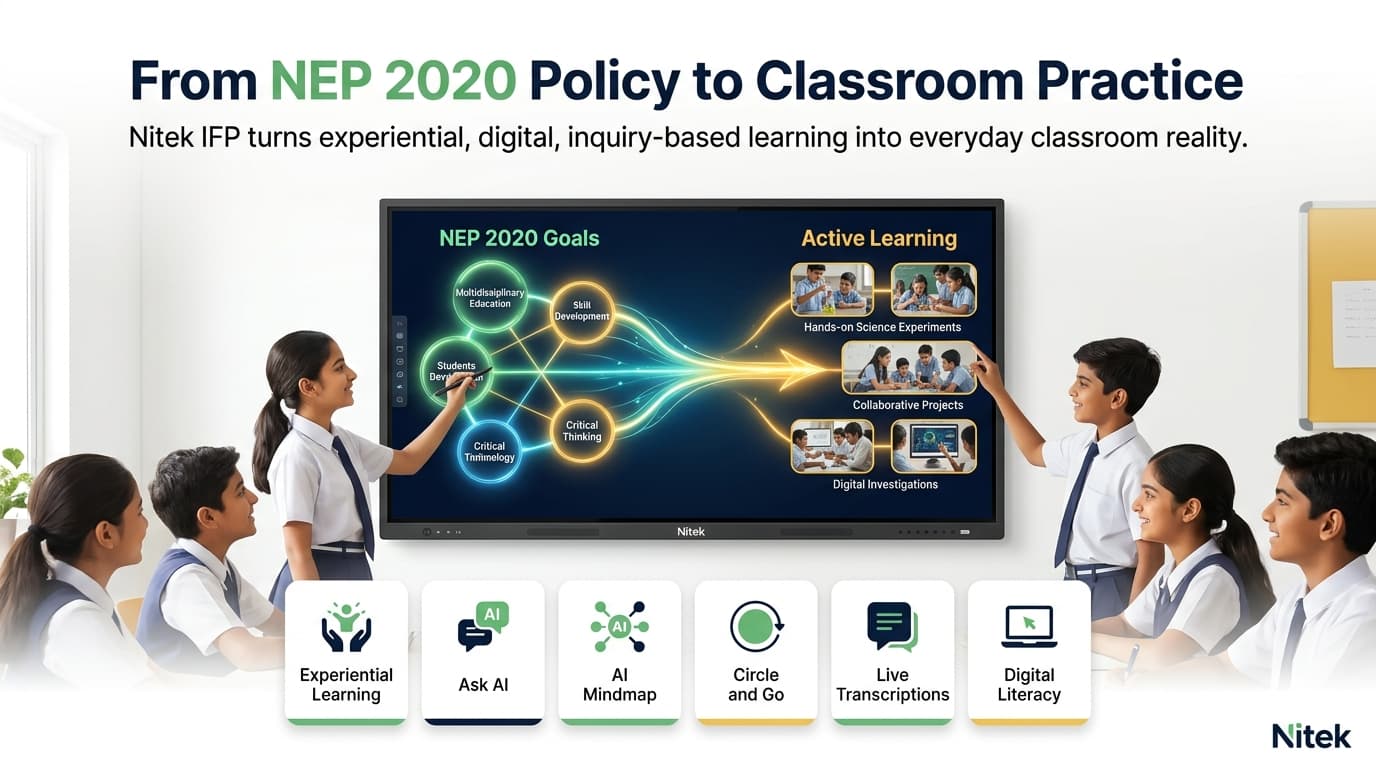
QUICK ANSWER: NEP 2020 mandates a shift from rote memorisation to experiential, inquiry-based, and technology-integrated learning. Interactive flat panels directly support this by enabling touch-based interactive lessons, AI-powered concept exploration, real-time collaboration, live transcription for inclusive classrooms, and instant visual content generation, replacing passive instruction with active, student-centred learning. Nitek's Android 16 IFP is built around exactly these pedagogical goals.
India's National Education Policy 2020 is the most significant restructuring of the country's education framework in over three decades. At its core, NEP 2020 calls for a fundamental shift in how teaching and learning happen in Indian classrooms: away from textbook-and-blackboard rote instruction, toward experiential learning, critical thinking, digital literacy, and the development of competencies over the memorisation of content.
For school administrators and teachers tasked with implementing NEP 2020 in practice, the policy's vision is clear. The pathway to getting there is less obvious. One of the most direct and scalable tools available to Indian schools right now is the interactive flat panel. Not because it is a piece of technology, but because of what it enables pedagogically when used with intention.
This article maps NEP 2020's key learning mandates to the specific capabilities of a modern interactive flat panel, showing where the alignment is genuine and where the IFP becomes a meaningful implementation tool for the policy's goals.
What NEP 2020 Actually Asks of Classrooms
NEP 2020 sets out several specific expectations for how teaching and learning should evolve in Indian schools. The most directly relevant to classroom technology are:
· A shift from rote learning to conceptual understanding and application
· Experiential and activity-based learning as the primary pedagogical mode
· Integration of digital tools and technology literacy into everyday instruction
· The teacher's role evolving from lecturer to facilitator and guide
· Inclusive education that accommodates different learning styles and abilities
· Inquiry-based and critical thinking-oriented approaches across subjects
· Art integration and multidisciplinary learning as core curriculum principles
Each of these mandates has a direct technology implication. And each one maps to a specific capability that a well-specced interactive flat panel brings to the classroom.
Experiential Learning: From Passive Listening to Active Interaction
NEP 2020's emphasis on experiential learning requires students to engage with content rather than receive it. The blackboard and chalk model, where a teacher writes and students copy, is inherently passive. An interactive flat panel changes the physical dynamic of the classroom.
On a Nitek interactive flat panel, students can come to the board and directly manipulate content: annotate diagrams, drag and sort information, interact with simulations, and build visual structures with their hands. The 40-point multi-touch capability means multiple students can engage with the board simultaneously, turning a lesson into a collaborative, hands-on activity rather than a one-way transmission.
Circle and Go on Nitek's IFP extends this further. A student can circle any word or concept on the board and instantly explore it through overviews, videos, and interactive content pulled from the browser. Curiosity becomes navigation. The student is not waiting to be told about a concept. They are exploring it.
NEP ALIGNMENT: NEP 2020 defines experiential learning as learning by doing, discovering, and reflecting. Circle and Go on Nitek's IFP makes this possible mid-lesson without breaking the instructional flow.
Moving Away From Rote Learning: Visual Thinking and Concept Mapping
One of NEP 2020's clearest instructions is to reduce the emphasis on memorisation and increase focus on conceptual understanding. Mind maps, concept hierarchies, and visual frameworks are established tools for building conceptual clarity rather than rote recall. The challenge has always been the time and effort required to create them in a live classroom setting.
Nitek's AI Mindmap feature directly addresses this. A teacher writes a topic name on the board and the IFP generates a structured concept map automatically, with connected nodes, sub-topics, and relationships mapped out in seconds. The class sees the conceptual structure of a topic immediately, and the teacher uses the remaining time to discuss, question, and deepen understanding rather than draw.
AI Painter complements this by generating visual representations from text descriptions written on the board. Abstract concepts become images. Geographic features, biological structures, and historical settings become instant visuals. NEP 2020's goal of concept-first, memorisation-second learning becomes practically achievable when the board can generate the visual context a concept needs.
Teacher as Facilitator: The IFP Shifts the Balance of the Classroom
NEP 2020 explicitly repositions the teacher from primary information source to learning facilitator and guide. This is a significant pedagogical shift, and it requires tools that support student-led inquiry rather than teacher-led delivery.
Ask AI on Nitek's interactive flat panel is one of the most direct enablers of this shift. When a student has a question that goes beyond the lesson plan, Ask AI answers it instantly on the board. The teacher does not need to have every answer. They facilitate the question, the student asks Ask AI, the answer appears, and the class discusses it. The teacher guides the discussion rather than delivering all the content.
Importantly, Ask AI on Nitek's IFP has no token limits and requires no external subscription. Every question a student asks is answered without cost constraints. In a NEP 2020 classroom where inquiry is encouraged rather than managed, an IFP with a built-in, unlimited AI assistant removes the practical barrier to student-led exploration.
NEP ALIGNMENT: NEP 2020 envisions the teacher as a guide who enables student inquiry. Ask AI on Nitek's IFP means students can pursue any question that arises in class, with the teacher steering the thinking rather than gatekeeping the content.
Digital Literacy: Building Technology Competence Through Everyday Use
NEP 2020 identifies digital literacy as a foundational competency for students in the 21st century, not a separate subject but a skill developed through regular interaction with technology across all subjects. An interactive flat panel in daily classroom use is one of the most natural ways to build this competency.
Students who interact with a Nitek IFP regularly, using touch to annotate, mirroring their phones to share work, exploring content through Circle and Go, and working with AI tools, develop an intuitive relationship with digital interfaces as part of their learning. This is exactly what NEP 2020 means by technology integration: not a computer lab period once a week, but technology woven into how every lesson runs.
Live Transcriptions on Nitek's IFP adds an accessibility dimension that NEP 2020's inclusive education framework specifically calls for. Students with hearing difficulties, processing differences, or those who simply learn better through reading alongside listening are supported without any additional device or specialist equipment. The board does it natively.
NEP 2020 Goals and Nitek IFP Features: The Direct Alignment
|
NEP 2020 Goal |
What It Requires in the Classroom |
Nitek IFP Feature That Delivers It |
|
Experiential learning |
Students interact with content, not just receive it |
40-point multi-touch, Circle and Go |
|
Away from rote learning |
Conceptual understanding through visual and applied thinking |
AI Mindmap, AI Painter |
|
Teacher as facilitator |
Student-led inquiry, teacher guides rather than lectures |
Ask AI (unlimited, built-in LLM) |
|
Digital literacy |
Technology embedded in daily learning across all subjects |
Android 16 OS, Wi-Fi, wireless mirroring |
|
Inclusive education |
All students can access and follow the lesson |
Live Transcriptions |
|
Inquiry-based learning |
Students explore questions as they arise in class |
Circle and Go, Ask AI |
|
Art and multidisciplinary learning |
Visual, creative thinking integrated into lessons |
AI Painter, annotation tools |
|
Critical thinking |
Students analyse, map, and connect concepts |
AI Mindmap, collaborative touch activities |
From Policy to Practice: What NEP 2020 Implementation With an IFP Looks Like
NEP 2020 compliance is not achieved by installing a technology tool and walking away. The interactive flat panel is an enabler, not a solution by itself. What makes the difference is whether the IFP is used in ways that reflect NEP 2020's pedagogical principles: student interaction over teacher monologue, concept exploration over content delivery, and questions welcomed rather than deferred.
Schools that deploy Nitek's IFP as part of a structured NEP 2020 implementation plan, with teacher training that covers not just how to operate the board but how to redesign lessons around it, consistently report higher student engagement, better conceptual retention, and a measurable shift in classroom dynamics toward the student-centred model NEP 2020 envisions.
For school administrators evaluating IFP options in the context of NEP 2020 requirements, the key question is not which panel has the largest screen. It is which panel's feature set most directly supports the pedagogical shifts the policy demands. On that measure, an Android 16 IFP with AI tools, multi-touch, and inclusive features is the most aligned technology investment a school can make right now.
Frequently Asked Questions
How does an interactive flat panel support NEP 2020 in Indian schools?
An interactive flat panel supports NEP 2020 by enabling experiential learning through touch-based interaction, reducing rote learning through AI-generated concept maps and visual tools, supporting the teacher-as-facilitator model through built-in AI assistants, building digital literacy through daily technology use, and ensuring inclusive learning through live transcription. Nitek's Android 16 IFP includes specific features aligned to each of these NEP 2020 goals.
Is an interactive flat panel a NEP 2020 compliant classroom tool?
Yes. NEP 2020 calls for technology integration, experiential learning, and digital literacy as core classroom requirements. A modern interactive flat panel with AI tools, multi-touch capability, and inclusive features like live transcription directly supports these requirements. It is one of the most policy-aligned classroom technology investments available to Indian schools in 2026.
What is experiential learning and how does an IFP enable it?
Experiential learning, as defined in NEP 2020, is learning through direct experience, interaction, and discovery rather than passive listening. An interactive flat panel enables experiential learning by allowing students to physically interact with content on the board, explore topics through tools like Circle and Go, and collaborate on activities using multi-touch features.
How does Ask AI on the Nitek IFP support NEP 2020's inquiry-based learning goals?
Ask AI is a built-in large language model on Nitek's interactive flat panel with no token limits. It allows students to ask any question that arises during a lesson and receive an immediate, detailed answer on the board. This directly supports NEP 2020's goal of inquiry-based learning, where student questions drive the lesson rather than a fixed content delivery plan.
Which Nitek IFP features align with NEP 2020's inclusive education mandate?
Nitek's Live Transcriptions feature converts spoken classroom instruction into real-time on-screen text, making lessons accessible to students with hearing difficulties and those who process information better through reading. This directly supports NEP 2020's inclusive education mandate without requiring additional specialist equipment.
The IFP Is Not Just a Technology Upgrade. It Is a Pedagogy Upgrade.
NEP 2020 is ultimately asking Indian schools to change how learning happens, not just what is taught. That change requires tools that make the new pedagogical approach practically possible in a real classroom with real teachers and real time constraints.
Nitek's interactive flat panel, built on Android 16 with AI tools including Ask AI, AI Mindmap, AI Painter, Circle and Go, and Live Transcriptions, is designed for exactly this moment in Indian education. Each feature maps to a specific NEP 2020 requirement. Each one makes the policy's vision more achievable in the classroom that actually exists today, not the idealised classroom of a policy document.
For schools serious about NEP 2020 implementation, the interactive flat panel is not an optional upgrade. It is the classroom infrastructure that makes the policy's goals operationally possible.
Explore how Nitek's IFP supports NEP 2020 implementation in your school at nitekifp.com.