
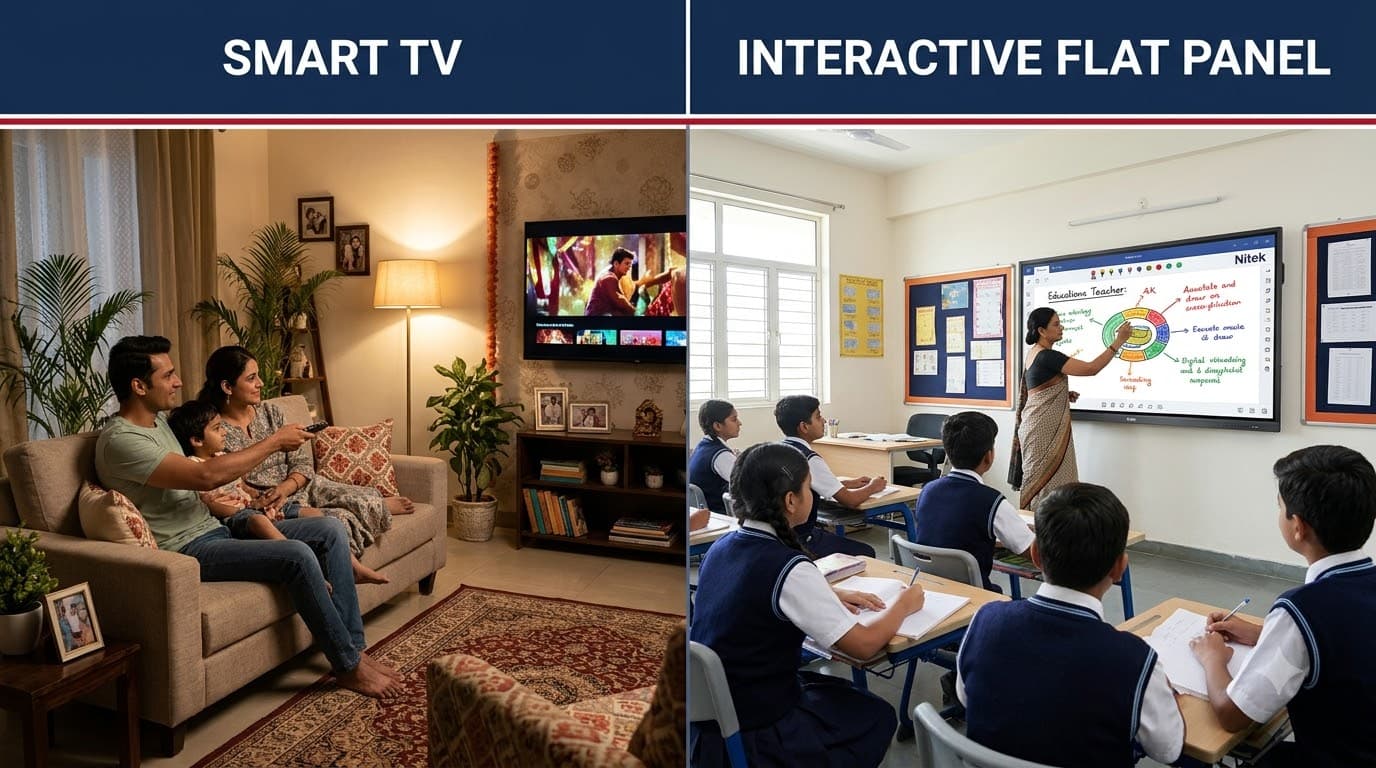
What is the Difference Between a Smart TV and an Interactive Flat Panel?
Written by Shravya Mehta, EdTech Specialist at Nitek IFP
Shravya Mehta
Official Blog Contributor
|
A smart TV is designed for passive viewing — streaming content, watching videos, and casual browsing. An interactive flat panel (IFP) is purpose-built for active use: multi-touch input, collaborative annotation, screen recording, classroom software, and continuous professional use in schools and boardrooms. |
Large flat screens are showing
up in classrooms and boardrooms across India at a fast pace. But there is a
critical question that most buyers skip: is what you are buying a smart TV or
an interactive flat panel? They look the same on the wall. The price gap is
smaller than you think. And choosing the wrong one for a school or office
setting is an expensive mistake.
A smart TV and an interactive flat panel serve completely different purposes and are built to different standards. Spending 60,000 to 2 lakh rupees on the wrong display means poor visibility in a lit classroom, no touch capability, a device that overheats after a few hours, and a warranty that does not cover professional use.
This guide breaks down every meaningful difference — and tells you exactly which one to buy for your institution.
Quick Comparison: Smart TV vs Interactive Flat Panel
|
Feature |
Smart TV |
Nitek Interactive Flat Panel |
|
Primary Purpose |
Passive viewing |
Teaching, collaboration & hybrid learning |
|
Touchscreen |
No |
Yes — 20-point multi-touch |
|
Screen Brightness |
250-400 nits |
400-600 nits |
|
Screen Durability |
Standard consumer glass |
Tempered anti-glare glass |
|
Built-in Whiteboard |
No |
Yes — pre-installed |
|
Screen Recording |
No |
Yes — built-in |
|
AI Tools |
No |
Yes — auto-framing, voice tracking |
|
Operating System |
Smart TV OS |
Android 16 (latest) |
|
Available Sizes |
Up to 85 inch typical |
55, 65, 75, 86, 98 inch |
|
Continuous Daily Use |
Not rated for 8+ hrs |
Rated for 16 hrs daily |
|
Warranty (India) |
1 year typical |
3 years (industry leading) |
|
Typical Lifespan |
3-5 years |
5-7 years |
|
Best For |
Home entertainment |
Schools, colleges, boardrooms |
The Key Differences Explained
1. Touch Capability
This is the most fundamental difference. Smart TVs do not have touchscreens — you control them with a remote. An interactive flat panel has a multi-touch display that responds to finger and stylus input. Nitek IFPs support 20-point simultaneous touch, which means a teacher can write on the board while multiple students interact with different parts of the screen at the same time. For classrooms and boardrooms, this is not a nice-to-have feature — it is the entire point of the display.
2. Screen Brightness and Visibility
Most smart TVs are designed to be watched in a dimmed living room, outputting 250 to 400 nits. Classrooms in India are brightly lit, often with large windows and tube lights running all day. Nitek IFPs output 400 to 600 nits, keeping the display clearly visible in a fully lit room without needing to draw curtains or dim anything. This alone makes smart TVs unsuitable for most Indian classroom conditions.
3. Screen Durability and Glass Quality
Smart TVs use standard consumer glass optimised for home viewing. Nitek IFPs use tempered anti-glare glass engineered to withstand daily writing pressure, accidental knocks, stylus use, and years of cleaning without degrading. A smart TV screen used as a classroom display will show wear and surface damage within months of regular touch use.
4. Operating System and Built-in Teaching Tools
A smart TV runs a streaming-focused OS — Android TV, Tizen, or WebOS — designed for Netflix, YouTube, and similar content. It has no whiteboard, no annotation tools, and no screen recording.
Nitek IFPs run Android 16, the latest version, and come pre-loaded with a full digital whiteboard, screen recording, split-screen mode, built-in browser, and full Play Store access for educational apps. They also include AI tools built in as standard: auto-framing (camera keeps the teacher centred on screen during recordings), voice tracking (follows the speaker across the room), and AI-assisted annotation. These are features most smart TVs cannot offer at all.
5. Continuous Use Rating
A smart TV is designed for two to six hours of home use per day. Running it for eight or more hours in a school will cause overheating, faster panel degradation, and in most cases will void the manufacturer warranty.
Nitek IFPs are rated for 16 hours of continuous daily use. The cooling system, panel, and internal components are all engineered for institutional environments where the display runs from the first class of the morning to the last session of the evening.
6. Connectivity for Classrooms
Smart TVs typically offer two HDMI ports and a couple of USB ports built for home peripherals. Nitek IFPs are built for classroom and boardroom connectivity: multiple HDMI inputs, USB-A and USB-C ports, a dedicated LAN port for stable wired internet, an OPS (Open Pluggable Specification) slot for an optional PC module, and built-in wireless screen mirroring compatible with Android, iOS, Windows, and Mac simultaneously — so any teacher or student device can connect instantly.
7. Warranty and After-Sales Support
A smart TV in India from Samsung, LG, or Sony typically comes with a 1-year warranty. Nitek IFPs come with a 3-year warranty as standard — the longest in this category in the Indian market. For a school that uses the display every single day, that extra warranty coverage directly reduces total cost of ownership and removes the risk of a large unplanned repair expense in years two and three.
8. Price vs Value
A 65-inch smart TV from a reputed brand costs 60,000 to 90,000 rupees. A Nitek 65-inch 4K IFP is competitively priced in the 80,000 to 1,20,000 range — a difference of 20,000 to 30,000 rupees. For that gap you get 20-point touch, 4K display, Android 16, AI tools, tempered glass, 16-hour daily use rating, and a 3-year warranty. For any school or professional setting, the value comparison is not close.
When Should You Choose a Smart TV?
A smart TV is the right choice when:
· Home entertainment: You need a display for streaming, watching cricket, or casual viewing at home.
· Reception area display: You need a screen to show static content or a looping video in a waiting area, with no need for touch or interaction.
· Budget is very tight: For very small classrooms with limited budgets where even a basic display is an improvement over a blackboard, a smart TV can serve as a passive display for showing pre-downloaded content.
When Should You Choose an Interactive Flat Panel?
An interactive flat panel is the right choice when:
· Classrooms and lecture halls: Any teaching environment where the teacher needs to write, annotate, or interact with the display. Nitek IFPs with 20-point touch and a built-in whiteboard are purpose-built for this.
· Hybrid and recorded lessons: You want to record lessons for absent students. Nitek's built-in screen recording and AI auto-framing camera make this seamless without any external equipment.
· Boardrooms and training rooms: Presentations, workshops, and collaborative meetings. Nitek's wireless screen mirroring lets any participant cast from their phone or laptop instantly.
· Government school procurement: NEP 2020 and PM eVIDYA schemes specifically call for interactive displays. Nitek IFPs meet these specifications and are already deployed in government-funded institutions across India.
· Long-term institutional use: You need a display that lasts 5 to 7 years under daily heavy use. Nitek's 3-year warranty and 16-hour daily use rating make it the lowest total cost of ownership option in its category.
|
NITEK: BUILT FOR INDIAN CLASSROOMS Nitek interactive flat panels offer 4K resolution, Android 16, 20-point multi-touch, built-in AI tools, and a 3-year warranty. Available in 55, 65, 75, 86, and 98 inch sizes. Trusted by 100+ schools and colleges across India. |
Which Interactive Flat Panel Should You Buy?
If you have decided that an interactive flat panel is the right choice for your school, college, or boardroom, the next question is which brand to buy. The Indian market has options from international names like BenQ, ViewSonic, and Samsung, as well as Indian manufacturers. Here is why Nitek stands out as the best interactive flat panel to buy in India in 2026.
· Purpose-built for Indian conditions: Nitek IFPs are designed with Indian classrooms in mind. The panels are calibrated for high-ambient-light environments, rated for the heat and humidity of Indian school buildings, and built to handle eight or more hours of daily use without thermal throttling or performance drops.
· 4K display with Android 16: Nitek panels deliver 4K Ultra HD resolution (3840 x 2160) and run on Android 16, the latest version available. This means sharper visuals than most competitors at this price point and access to the full Play Store ecosystem of educational apps without compatibility issues.
· Built-in AI tools as standard: Nitek includes AI-powered features that most brands charge extra for or do not offer at all: auto-framing keeps the teacher centred on screen during recordings, voice tracking follows the speaker across the room, and AI annotation assists with on-screen writing. These tools make hybrid and recorded lessons significantly easier for teachers.
· 3-year warranty — the longest in this category: Most IFP brands in India offer a 1 to 2-year warranty. Nitek offers 3 years as standard. For a school that uses the panel every day, this translates directly to lower maintenance costs and less risk of a large unplanned expense in years two and three.
· Sizes from 55 to 98 inches: Nitek manufactures panels across the full range of classroom and boardroom sizes. Whether you need a 55-inch for a small tutorial room or a 98-inch for an auditorium, you can standardise on one brand across your entire institution rather than mixing suppliers.
· Trusted by 100+ institutions across India: Nitek panels are already deployed in schools, engineering colleges, and corporate training rooms nationwide. That track record matters when you are making a procurement decision for an institution, as it reflects real-world reliability rather than just spec-sheet claims.
· Local service and support: Buying from an Indian manufacturer means after-sales service that does not require international escalation. Nitek's support team operates locally, which means faster response times and on-site service where needed, a significant advantage over imported brands whose service network in India can be limited outside major cities.
|
READY TO SEE NITEK IN YOUR CLASSROOM? Nitek offers free demonstrations at your institution across India. Visit nitekifp.com or contact the Nitek team to get a customised quote based on your classroom size, number of rooms, and budget. |
Frequently Asked Questions
|
Q Can I use a smart TV as an interactive flat panel in a classroom? |
|
Technically you can connect a smart TV to a laptop and use it as a passive display. However, it will not have a touchscreen, built-in whiteboard, screen recording, or professional durability. For serious classroom use, a smart TV is not a substitute for an interactive flat panel. |
|
Q Is an interactive flat panel just an expensive smart TV? |
|
No. An IFP and a smart TV share a similar form factor but are built for completely different purposes. An IFP has touch input, hardened glass, a higher brightness panel, professional cooling, commercial-grade software, and a longer warranty. The price difference is modest compared to the capability gap. |
|
Q Which is better for a school in India, a smart TV or an IFP? |
|
An interactive flat panel is significantly better for schools. Indian classrooms are bright, classes run for several hours, and teachers need to write and interact with the display. Smart TVs are not rated for this kind of use and will underperform and degrade quickly in a school environment. |
|
Q Does an interactive flat panel need a separate computer to work? |
|
No. Most interactive flat panels, including Nitek IFPs, have an embedded Android computer built in. Teachers can access apps, browse the internet, run lessons, and record screens without connecting any external device. |
|
Q What is the price difference between a smart TV and an interactive flat panel in India? |
|
A quality 65-inch smart TV costs approximately 60,000 to 90,000 rupees. A 65-inch interactive flat panel costs 80,000 to 1,20,000 rupees. The difference is 20,000 to 30,000 rupees for a device with touch capability, professional durability, built-in teaching tools, and a longer warranty. |
Conclusion
A smart TV and an interactive flat panel look the same on the outside but are fundamentally different products built for different environments. Smart TVs are excellent for home entertainment. Interactive flat panels are purpose-built for schools, colleges, corporate training rooms, and boardrooms where the display needs to be touched, written on, and used for eight or more hours every day.
If you are equipping a classroom or meeting room in India and are weighing up the options, the honest answer is that a smart TV will disappoint in a professional setting within a year. An interactive flat panel built for institutional use will serve your teachers and students far better over the long term.
Nitek offers 4K interactive flat panels from 55 to 98 inches with Android 16, multi-touch, built-in AI tools, and a 3-year warranty. Reach out to the Nitek team for a demo or customised quote for your institution at nitekifp.com.